

Check it: I have a new short story out in the latest issue of Reading Into Culture, Lições do Seu Fantasmo Vovô. It’s about a dead, Brazilian, possibly-fascist grandfather haunting his trans grandson. I’m thrilled that this one is out in the world, and you can hear me read the story and talk about it in the Reading Into Culture podcast. (Also on Spotify.)
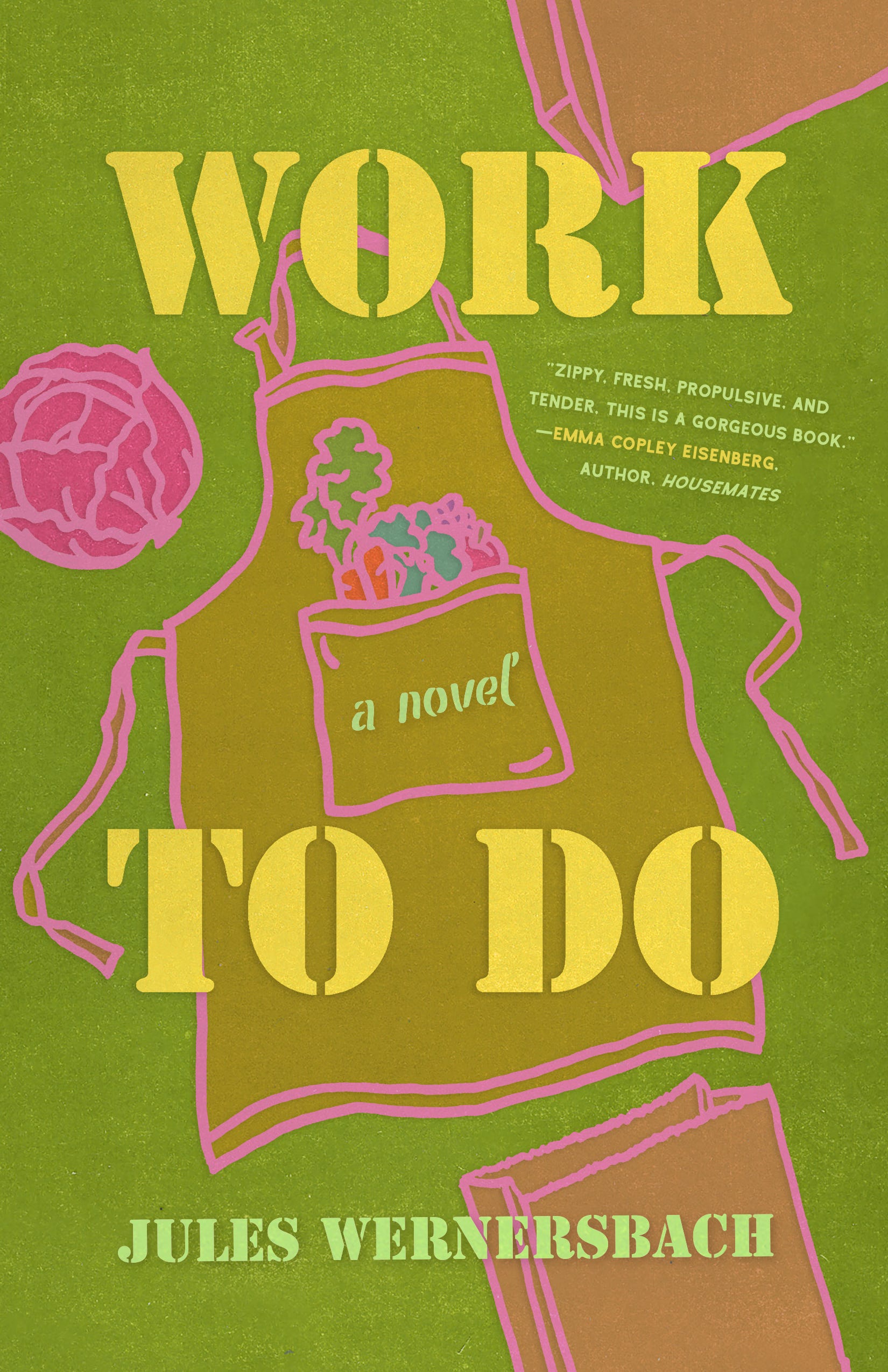
I read an arc of this novel because Jules Wernersbach runs my favorite queer bookstore, Hive Mind Books in Brooklyn. Serious shout-out to Hive Mind—if you live around NYC and have never been, definitely check it out, because every time I visit I discover some new-to-me queer book that I’d never heard of before. And their event programming is top-notch, the last time I visited the city I went to one of their queer open-mics and it was such a life-affirming experience that made me feel warm and welcome despite no longer living in the city. Hive Mind is so dear to my heart that I figured its co-founder’s debut novel would have an interesting perspective on small-business work, and I was not disappointed.
Work To Do, out in April from University of Iowa Press, dumps the reader right in to the eponymous work: we accompany Roz, the middle-aged queer senior manager of the Guadalupe Street Co-Op in Austin, as she fulfills one task after another. Outside, a hurricane builds; water drips from the leaking roof in the back, ruining several heads of broccoli. The produce fridge is a mess, and a customer want kale but there’s none to be found. The aisles are filled with disgruntled customers, cramming into the store in a futile attempt to get their groceries before the big storm, swiftly baring the shelves of all necessities. They’re understaffed, and Roz has been called in on her day off. To the kale-desirous customer, she can offer only rainbow chard, and for her efforts the customer complains that chard is not the same. Roz, having worked at the co-op for a decade, knows this: “She knew the difference between chard and kale, turnips and parsnips, hippies and yuppies and boomers and hipsters and people like her: workers.”
Work To Do is a workplace novel, one in which the characters are driven first and foremost by their jobs. The novel takes grocery store retail work seriously, and for Roz, Eleanor, and Randy, the three perspectives we inhabit, their work is not simply one aspect of life–work is their life. This is a novel that believes in and advocates for the dignity of work, the kind of work that most of us usually take for granted. Roz’s relationship with Molly, a floor worker, is constantly threatened by how much time she must devote to the store; Randy is a floor worker and organizer facing such financial precarity that, when their roommates decide to move out and stick them with rising rent, they’re faced with the decision to move back into their old tent. Eleanor is the store’s co-founder and current owner (along with several shareholders), and the only worker who seems to have achieved financial prosperity, but when the novel opens she’s facing a serious health scare.
All three of our POV characters are middle-aged, and I found it both refreshing and, if I’m honest, a little scary, to read a novel whose middle-aged characters have not achieved the stability, happiness, or markers of achievement we generally associate with middle age. For myself, forty is right around the corner, and part of me still wants to believe that when I reach those middle decades, I’ll have “really” grown up, and financial stability and career success will fall into my lap as easily as chronic pain fell into it during my thirties. But these characters haven’t chosen (or lucked into) careers that guarantee them any kind of certainty. If anything, this novel points out that precarity is scarier when it happens to you at a more advanced age. “Their knees were not coming back,” Randy thinks to themself. “Middle age was the moment when your death would no longer be a tragedy of lost youth, when you had about fifteen years before an invisible scrim dropped between you and the interest of the world. Would there be such a thing as retirement for them?” This passage sent a shiver of foreboding down my spine. It’s not comfortable to inhabit the perspective of a middle-aged person potentially facing homelessness, with no windfall or deus-ex-machina coming their way, and Work To Do takes an approach to these characters’ precarity that is matter-of-fact and direct, asking the reader not to look away.
In the midst of the hurricane, the store loses power, and in her attempts to restore order, Roz unwittingly becomes responsible for an employee’s injury. The moment is caught on camera, adding fuel to the fire of the employees’ determination to advocate for themselves. Work To Do begins on the eve of the employees’ declaration of a union, and it swiftly becomes clear that the storm is only the outward manifestation of the co-op’s inward chaos and strife.
The stakes of unionization are abundantly clear, as none of the employees make a wage that can keep up with Austin’s rising costs of living, and even Roz, as the manager, doesn’t make enough money to grant her health insurance. Eleanor is adamant that she’ll close the store before she recognizes the union; the workers are determined to walk if the union’s demands aren’t met; but the co-op is barely turning a profit, and even Eleanor doesn’t have the power to make more money come from nothing. It’s a generational clash along with an ideological one, as Randy is among the oldest of the workers, and Eleanor dismisses most of the union-hopefuls as naive Gen Z idealists, taking organizing pointers from Instagram and expecting the world to conform to their notions of SJW utopia. The places are then set for a face-off that unfolds over the novel’s pages, as we get to know this place of work and the workers who keep it running.
Everyone involved in the Guadalupe Street Co-Op cares deeply about the store, from the workers to Roz all the way up to Eleanor. For Eleanor, the store is everything–we learn through intermittent flashbacks that she founded it with her ex-girlfriend Meg (whom she still burns a torch for), and that aside from Meg, the other co-founders are dead. It’s a link to her past with Meg and it’s also the great project of her life, and she believes that no one else in the store has sacrificed as much for its success. Roz’s life also revolves around the store, around the work that she’s made a cornerstone of her identity. Unlike Eleanor and Randy, Roz comes from money, and knowing that she’s disappointed the ambitions of her suburban mother–who wanted her to go to college and get a more impressive, white-collar job–makes her throw herself into work all the harder, and as a middle manager she’s somewhat caught in the middle, but she largely takes management’s side over the workers. And Randy, who’s worked at the co-op even longer than Roz, believes in the value that their work has for the world, and believes that they and their co-workers deserve to be compensated fairly. There is a kind of reverence for the store itself that comes across in all three perspectives, the store becoming intimate to the reader, a solace and friend to the novel’s characters.
“Randy felt a kinship with the industrial-size rolls of plastic wrap and aluminum foil, the dry-erase board with a running list of what needed to be ordered… The building was a coworker. The very walls were in solidarity.”
In addition to the overarching narrative of the union vs. management, relationship dramas play out among the main cast. Roz is still hung-up on her ex-wife Audrey, a meteorologist whose career, while they were married, granted Roz some of the white-collar sheen that her mother so wanted for her. Roz’s commitment to the store results in her taking her current girlfriend, Molly, somewhat for granted, with the result being that Molly might be falling in love with Randy, and–in possibly a worse betrayal–goes behind Roz’s back to help the union organizers in secret. Eleanor is hung up on her ex, haunted by her long list of past mistakes, and in denial about her failing health, instead laser-focused on keeping control of the store, determined not to give the union a single inch. The queer subplots are woven together with the unionization plot so that they feel one and the same, fitting for characters whose lives are defined by their work.
My wife has worked for a grocery store for many years, so I got a kick out of recognizing so much of the vocabulary she frequently refers to, and–since I’m always of the opinion that my wife deserves to be paid more and treated better by her workplace–I lived vicariously through the store employees’ activism. Naturally, I was rooting for the union, and the novel itself makes this easy–it comes down on the workers’ side, which would be hard not to do while giving the reader an honest portrayal of how hard these people work vs. their financial precarity.
Yet it’s a testament to this novel’s subtlety and thoughtfulness that it treats the management’s perspective with equal care and respect. Eleanor and Roz are well-realized, fleshed-out characters, and while reading their POV chapters we understand and sympathize with their motivations and concerns. Even Eleanor, with her big house in the country and her miserly ways, is always treated fairly by the narrative. It’s easy to understand why she behaves the way she does, and she’s never villainized. The novel portrays the conflict between the higher-ups in a barely-profitable small business and its low-paid workforce with great care, showing us each side of the conflict in measured detail.
Wernersbach’s prose style is clear-eyed and pointed, with characters’ motivations and emotions laid out sharply on the page. Lyricism is reserved for their feelings about work, for their longing towards the past, and for the city and natural environment surrounding them. When another hurricane breaches the walls of the store:
“The rain comes in as if invited, along with dirt and rocks and Styrofoam cups and all of the grit of Guadalupe Street. The wind grabs handfuls of merchandise, all of the foil-wrapped chocolates at the checkouts, the packages of gum and licorice, the magazines about living a better life, mugs and socks and tea strainers, and launches it deep into the store, spinning inventory above their heads that Eleanor cannot count or control.”
While its characters run around trying to control their work lives as much as possible, the environment steps in to demonstrate the ultimate folly of this control.
Queerness is everywhere in this novel, which makes sense, because you’ll also find queer people everywhere in retail environments. These are queers whose lives are neither glamorous nor urbane; mostly, they’re struggling to get by, finding salvation in the work there is to do. Wernersbach tells us about their love and sex lives with the same candor that she writes about their work lives, making the romantic subplots a blast to read. (There is a substantial aside about sex toys in Molly and Roz’s relationship that I particularly enjoyed.)
I loved reading a novel about people that remind me so much of my wife and her friends, the people that keep us all fed. Work To Do is keenly aware of the interstore politics that crop up in these retail environments. One of the underlying tensions in Work To Do is that Roz, coming as she does from money, has a safety net to fall back on that the other characters lack, but despite this safety net her desire to spend her life doing fulfilling, meaningful work rather than languishing behind a desk is always treated with respect–she’s not painted as a child of privilege goofing off before getting a “real” job, even if the other characters sometimes see her that way, but as someone whose decision to stay in this life deserves respect. It’s all relative, anyhow: in one of my favorite insightful passages, Eleanor, a white woman from a working-class background, recognizes that even in her lifetime of retail/food service labor, she’s been viewed as someone who has an out from The Life: “She had enjoyed her dining hall work… Eleanor had been white and young and [her coworkers] believed she was going places and it made her sad to realize they had seen her as just another version of the students all this time.”
For as much as this novel makes you feel the sweat, tears, and chaos of working at a grocery store, it also makes you feel the rewards. The pride its characters take in their work glows off the page, and it’s easy to understand why none of them can let go of the co-op. And they should be proud: they’re feeding people, preserving community, and with the union, standing in solidarity with each other. Through sticking close to its characters, the novel underlines the point that the people who work their asses off to feed us should be acknowledged, respected, and paid better, should be able to live with comfort and dignity. Work To Do is a love letter to such people, those who work jobs that keep the rest of our world running smoothly, who don’t get enough recognition or money for their labor. I’m glad this book exists, and if you like queer novels, labor novels, or simply love getting an expert view into idiosyncratic worlds, you won’t want to skip this one.