

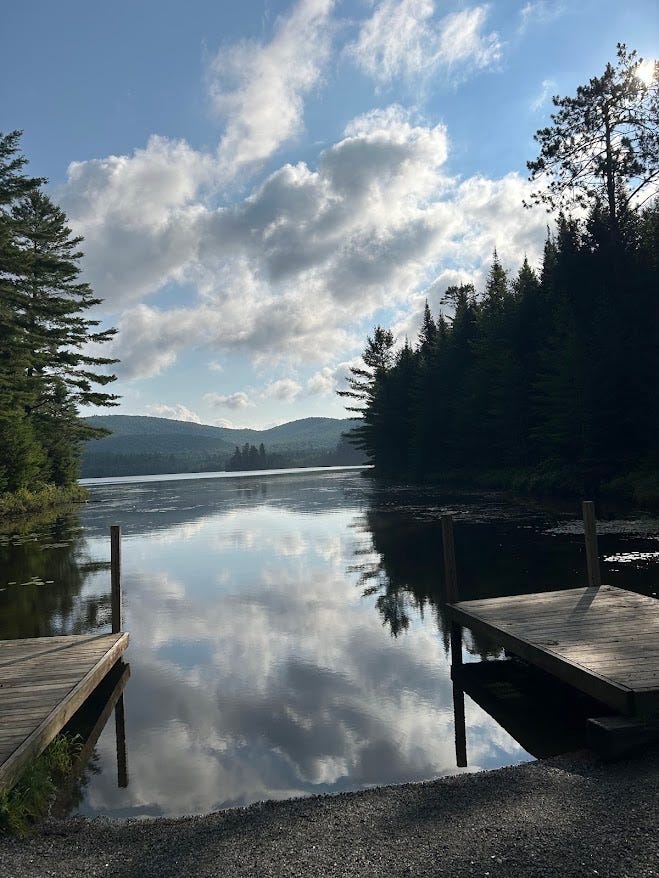
On Sunday, in the Adirondacks, I left my dog with my friends at the campground and took myself for a swim in the adjoining lake. (No dogs were allowed on the beach or in the water.) I was set to drive back to Syracuse in a few hours, but Sunday was the first sunny day of my weekend trip, blue sky peeking through the trees like a returning loved one, and I didn’t want to end this trip without first taking a dip in the lake.
It wasn’t that hot; I wasn’t driven to cool down. It’s more that it was important for me, in judging whether the trip had been good or bad, “worth it,” to swim in that lake before I drove home. I didn’t take a towel to lie on, or a book to read on the shore, or even sunscreen. I just swam, feeling lightly self-conscious being there by myself, particularly in my trans body, surrounded by other families swimming with their children. I practiced floating on my back. I swam around the lake’s edge for a while, until I grew bored, which happened quickly. I enjoyed being in the water, but my desire to go swimming wasn’t solely a desire to spend a great length of time in water; it was also the desire to have gone in the lake, to say that I did it. I don’t know how long I was in the water–fifteen, twenty minutes? Then I toweled off and packed up my car and collected my dog and said goodbye to my friends, and drove four hours home.
When I journaled about the weekend, I wrote that this had been the fourth lake I’ve swam in this summer. I then wondered why I’d had the compulsion to count, as if I was notching my bedpost. Was I bragging? Competing against someone in a count of lake-swims? Proving something to myself? Back in May, when the summer stretched out without end in sight, I didn’t set any goals for myself for the number of times I wanted to swim in a lake. But of course I was thinking along those lines, even if I didn’t articulate it. When I conceptualized what I wanted out of my summer, I was thinking that I wanted to go swimming, because a good summer, to me, calls to mind images of bodies of water. I did not, consciously, set out to count the number of times I’d go swimming, but a count began running regardless. My mind sets metrics whether I tell it to or not.
On Saturday, as we raced to put all our camping chairs under a tarp as another wave of rain hit our heads, I was feeling resentful of the weather. Earlier in the day, while hiking, we’d been caught in a torrential thunderstorm, slogging down a trail that had become a muddy creek, our soaked clothes sticking to our skin, thunderclaps deafening us from directly overhead. After that, I thought surely we were owed sunlight, but the rain kept coming back. I struggled with my resentment, feeling that I was the only one whose positive attitude was hanging by a thread. Why had I signed up for this? Why had I wanted to expose myself to the elements? My friend, extending a previous conversation examining the appeal of camping—why did we like this when the experience removed so many creature comforts—said, “Maybe camping is about survival.”
Is camping about survival, something to be enjoyed as much after the fact–I did that, we did that–as it is a sensory pleasure in the moment? I get sensory pleasure out of watching a campfire burn in darkness, out of roasting s’mores, out of looking up at a night sky of stars framed by tree silhouettes. I get no sensory pleasure from trying to sleep in a tent or the struggle of trying to keep my stuff dry when it rains. Is gratitude for survival about feeling a sense of accomplishment? Is anything I do not about a sense of accomplishment? Am I incapable of enjoying one summer without metrics of accomplishment?
Every year I set a reading goal for myself, because I have learned from experience that when I don’t set a metric, I read fewer books. (And without Letterboxd to track my watches, I watch fewer movies.) But setting a metric alters the experience. When I know I’m working towards a goal, I can’t help but read less for pleasure and more for the sake of adding a number to my list. Reading becomes something I do for the sake of productivity. I worry that counting the number of times I’ve gone swimming turns what should be a pure Id-driven pleasure into yet one more activity undergone for the sake of my ego and organized by my superego.
Like every summer, this one has disappeared as swiftly as water flowing downstream, the time here and then gone in the space of an Instagram upload. I don’t have any talent for documenting my life for social media, yet my life still feels dominated by social media logic: if you can’t show off the fun you’re having, if no one else is impressed, then the fun you had didn’t matter. Fun is most fun when you can show it off, brag about it. Fun becomes one more thing to measure with a metric. I am almost never just “having fun” without the metacognition of quantifying how much fun I’m having and how I might compare my fun to others.
I knew, back in May, that I didn’t want to “waste” my summer. But with all this free time, months of it gifted to me like it never was when I worked 9-to-5, what would waste have looked like? To me, it would have looked like failing to meet my writing goals; but paradoxically, it would have also looked like failing to get properly outside, failing to do fun summery things, failing to have adventures. I wanted to find the perfect balance between productivity and fun, between accomplishment and enjoyment, and I knew I would feel a sense of accomplishment if I enjoyed myself to the fullest, and that I’d feel like a failure if I spent all my time sitting around both bored and unproductive.
The language of failure betrays the way I can’t approach anything without the intervention of capitalist logic. Even when I’m having fun, I must be working towards something, even if that “something” is just my mental health. There is an uncomfortable similarity between the logic of capitalism and the logic of self-care; the idea of “self-care” takes the pleasure of doing what feels good and turns it into another goal. Even when I manage to waste time, to do something for pure pleasure, pure distraction—hanging out with my friends, enjoying a TV show —I become pleased with myself because I know that relaxation is good for me, that it’s necessary, and therefore I’ve accomplished something even through accomplishing nothing. A double-bind.
One of the best things about fandom obsession is that it cuts through the double-bind. For me, genuine hyperfixations have a way of evaporating capitalist logic. Suddenly, I’m not wracked with indecision about how to spend my time, because the pull of obsession makes that decision for me. After the fact, I might still feel guilty about “wasting” my time on my new fandom interest, but that guilt isn’t enough to spoil my enjoyment, nor is it enough to pull me fully away from the obsession and force me into productivity. Hyperfixation is not something that can be forced, or at least, I do not know how to force it. It’s purely organic, it either happens or it doesn’t. If I could have induced myself to be obsessed with In Search of Lost Time, I would have; in that case I would’ve burned through the entire book by now, instead of taking two months to read just the first volume. I almost achieved a hyper-fixation with my novel back in May, when I raced to finish my first draft, but I couldn’t sustain that obsession when it came to revision.
As it always happens, I couldn’t have predicted the two hyperfixations that took my summer by storm: The World Cup, and a D&D actual play podcast called Dungeons and Daddies. While both of these obsessions burned hot, I didn’t have to make choices about how to fill my free time—the obsession chose for me. The freedom brought by obsession blew away any shame I might have felt upon being so unproductive.
When The World Cup was on, I spent as much time as I could watching soccer, and when there weren’t games on I watched YouTube videos about soccer or read about it online. Since the Cup ended, I’ve been entirely unmotivated to consume soccer content, the obsession blinked off almost immediately. I can hardly remember being the person I was when it was happening, that sports fan I’d never met before this summer.
Dungeons and Daddies became more than just a podcast I listened to while doing chores or walking my dog; as its season two kicked into high gear, I spent whole evenings listening to hours of it, sometimes while crocheting or smoking weed, sometimes while pacing the living room, sometimes simply while sitting. Sometimes I marveled at myself, at how much fun I was having listening to other people play a game. At least with the World Cup, I shared my fandom with much of the world, I could talk about the games with friends, show off what I was learning about the sport; when you’re obsessed with a podcast, there’s nothing to show off. There’s no Letterboxd for podcasts, no bragging rights. I spent hours and hours listening to it for nothing but my own enjoyment, and now that the obsession doesn’t burn so brightly, I miss it, as I miss the World Cup.
When I think about whether or not it’s been a good summer, I think about all the things I’m proud of, the things I did that come with bragging rights, but I also think about these hyperfixations that meant nothing to anyone save for myself. I think about how good it felt to simply enjoy myself without worrying about self-care, or my film and book goals, or competing with myself. It felt so good to get completely wrapped up in a geeky interest, to “waste” that time. Am I soiling the purity of that wasted time by writing about it, turning my enjoyment into content? Maybe I would be less susceptible to the double-bind if I wasn’t a writer, if my writing instincts didn’t constantly keep the fires of metacognition burning. Or maybe this tendency is universal, I have no idea. My own interiority is the only kind I can possibly experience; I don’t know what it’s like for you, if you might be more capable of enjoying something without simultaneously considering what it means for you to enjoy it.
Now I have these last precious two weeks before school resumes. I have two more weekend trips planned, incredibly fun adventures on the horizon, here I go again, bragging. Trying to prove something that no one has asked me to prove. Contorting the pleasure of being alive into the march of productivity. I can feel myself seeking around for another obsession, for an infatuation with something that might erase my competitive urges, my need to feel that summer is an enemy I’ve conquered, something that will let me be rather than urge me to strive.
When my classes start, the need to be productive will be externally commanded, capitalism logic demanding that I do the assigned reading, finish assignments, teach my class. Truthfully, I’m looking forward to it; it’s been a good summer, but I could use some more structured time.